
If you’ve been hunting for the top affordable SUVs for growing families in 2026, you already know the struggle is real. Car seats, soccer gear, groceries, maybe a dog thrown in for good measure. Your sedan isn’t cutting it anymore, and your budget hasn’t magically doubled. I get it. My wife and I just went through this exact process with baby number three on the way, and honestly, the SUV market right now has some genuinely impressive options that won’t drain your savings account dry.
1. Kia Telluride: Still the King of Value
The Telluride has been dominating family SUV conversations for years, and the 2026 model keeps that streak alive. Three rows of seating, a V6 with 291 horsepower, and a starting price that stays under $38,000 make it almost unfairly competitive.
What really sold me was the back seat. My kids have room to breathe without kicking each other, which, if you’re a parent, you know is worth its weight in gold. The infotainment system is intuitive, the safety suite is loaded, and Kia’s warranty coverage remains one of the best in the industry. If you want maximum space for the money, start here.
2. Hyundai Palisade: The Telluride’s Refined Cousin
Hyundai and Kia share a platform, so the Palisade gives you a similar foundation with a slightly more polished interior. The 2026 refresh brought an updated 12.3-inch touchscreen and improved sound insulation that makes highway drives noticeably quieter.
Starting around $37,500, you get the same powertrain as the Telluride but wrapped in what feels like a more premium package. I sat in both back-to-back at a dealership, and the Palisade’s second-row captain’s chairs felt a touch more comfortable. It’s a close call between these two, and honestly, you can’t go wrong with either one.

3. Chevrolet Traverse: Big Space, Reasonable Price
Chevy completely redesigned the Traverse for the 2024 model year, and the 2026 version carries forward everything that made the redesign successful. It’s one of the roomiest three-row SUVs in this price range, with a turbocharged 2.5-liter four-cylinder producing 315 horsepower.
Starting around $36,500, the Traverse gives you legitimate truck-like cargo space without the truck-like fuel economy. I borrowed my neighbor’s for a weekend camping trip, and we fit two adults, three kids, a cooler, a tent, and two folding chairs without playing Tetris. The ride quality is smooth, the tech is solid, and GM’s build quality has genuinely improved in recent years.
4. Toyota Grand Highlander: Built to Last Decades
Toyota reliability isn’t a myth. It’s the reason you still see 2008 Highlanders rolling around with 250,000 miles on the odometer. The Grand Highlander, Toyota’s stretched version of the standard model, starts around $39,500 for the 2026 model and delivers that legendary durability with significantly more passenger room.
The hybrid version is where this SUV really shines for families. You’re looking at roughly 36 mpg combined, which saves serious money over the life of the vehicle. Third-row legroom is tighter than the Telluride, but it’s workable for kids and shorter adults. If you plan to keep your SUV for 10-plus years, this is probably the smartest financial pick on this entire list.
Top Affordable SUVs for Growing Families: The Midsize Sweet Spot
Not every family needs a three-row behemoth. If you have two kids and no plans for a third, a midsize two-row SUV often makes more sense. You get better fuel economy, easier parking, and a lower price tag. The sweet spot for many growing families falls right in this category.
Subaru Outback
Starting under $32,000, the Outback gives you standard all-wheel drive, incredible visibility, and a wagon-like cargo area that swallows strollers whole. It’s not flashy, but it’s relentlessly practical.
Mazda CX-70
Mazda’s CX-70 starts around $40,000, which pushes the “affordable” definition a bit, but the interior quality punches way above its price. It looks and feels like a luxury vehicle without the luxury markup. The inline-six powertrain is responsive and fun to drive, which matters when you’re behind the wheel for hours every week.

5. Honda CR-V: The Sensible Choice That’s Actually Good
I know, I know. The CR-V isn’t exciting. Nobody brags about their CR-V at a barbecue. But here’s the thing: it consistently ranks as one of the best-selling SUVs in America for a reason. The 2026 model starts around $32,500, and the hybrid version bumps that to roughly $34,000.
The cargo space is absurdly generous for a compact SUV. Honda engineered the rear seats to fold completely flat, creating a loading floor that makes moving furniture surprisingly doable. My sister-in-law has hauled a dresser in hers. Safety ratings are top-tier, and Honda Sensing comes standard on every trim. For families with one or two kids who don’t need a third row, this is one of the most practical vehicles money can buy.
6. Ford Bronco Sport: For the Adventure-Loving Family
If your weekends involve trailheads and campgrounds more than shopping malls, the Bronco Sport deserves a serious look. Starting around $33,000 for the 2026 model, it’s compact enough for city driving but genuinely capable off-road, especially in the Badlands trim with its twin-clutch rear axle.
I took one through some muddy forest roads in Oregon last fall, and it handled everything without breaking a sweat. The cargo area features a rubberized floor and built-in tie-downs that make cleaning up after muddy adventures painless. It won’t fit as much stuff as a CR-V, but it’ll take your family places a CR-V simply can’t go. That trade-off is worth it for the right family.
7. Kia EV9: The Electric Option That Actually Makes Sense
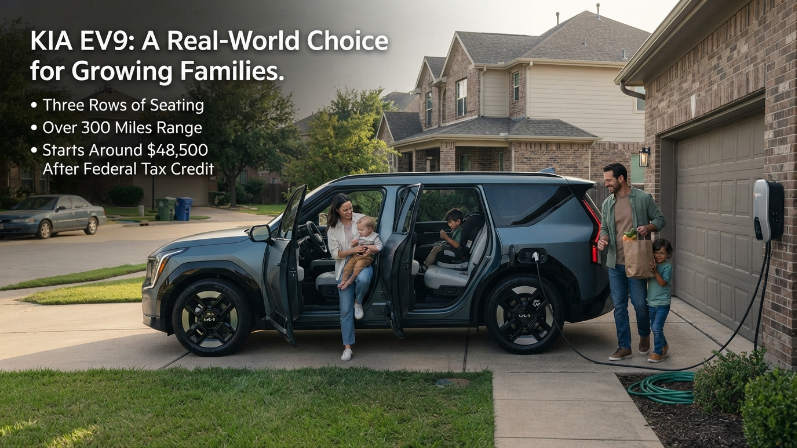
Electric SUVs used to feel like a compromise for families. Not enough range, not enough space, too expensive. The Kia EV9 changes all of that. The 2026 base model starts around $56,000, but after the federal tax credit (up to $7,500 if you qualify), you’re looking at closer to $48,500 out the door.
Three rows of seating, over 300 miles of range on a full charge, and a cabin that feels like a living room on wheels. Charging costs roughly a third of what you’d spend on gas for a comparable SUV over a year. My buddy switched from a Highlander to an EV9 six months ago and says his monthly fuel savings alone cover half his increased car payment. If you have home charging available, this is a genuinely affordable long-term choice for a growing family.
What to Actually Prioritize When Shopping
Price stickers grab your attention, but the real cost of ownership includes insurance, fuel, maintenance, and depreciation. A vehicle that costs $3,000 more upfront but saves you $800 a year in fuel ends up cheaper within four years. Run those numbers before you commit.
Safety ratings matter more than horsepower when you’ve got car seats in the back. Check IIHS and NHTSA scores for every model you’re considering. Every SUV on this list scores well, but specific trim levels and optional packages can affect crash test results.
Test drive with your actual car seats installed. I’ve seen families fall in love with a vehicle online only to realize the LATCH anchors are buried behind the seat cushion or the door opening is too narrow for their infant carrier. Twenty minutes at a dealership saves you years of frustration.
Frequently Asked Questions
What’s the best affordable three-row SUV for families in 2026?
The Kia Telluride and Hyundai Palisade trade the top spot depending on your priorities. The Telluride edges ahead on rugged styling and slightly lower pricing, while the Palisade offers a more refined cabin experience. Both deliver exceptional value under $40,000, and both have earned loyal followings among parents for good reason.
Are hybrid SUVs worth the extra cost for families?
Absolutely, especially if you drive a lot. The Toyota Grand Highlander Hybrid saves roughly $1,200 to $1,500 per year in fuel compared to its gas-only counterpart. Over a typical ownership period of five to seven years, that savings easily covers the hybrid premium and then some.
Which top affordable SUVs for growing families hold their value best?
Toyota and Subaru consistently lead in resale value. The Grand Highlander and Outback lose less value over five years than most competitors. Kia and Hyundai have improved dramatically in this area too, though they still trail Toyota by a small margin on average depreciation rates.
How many car seats can you fit in a midsize SUV?
Most midsize SUVs comfortably fit two car seats across the back row. Three is possible in wider models like the Traverse and Telluride, but it gets tight depending on the car seat brand. Narrow-profile seats from Diono are popular among three-across families for exactly this reason.
Is it better to buy new or used for a family SUV in 2026?
Used SUV prices have normalized after the pandemic spike, but demand for popular family models like the Telluride keeps used prices stubbornly high. If the price difference between a one-year-old used model and a new one is under $3,000, buying new often makes more sense because you get the full warranty and latest safety tech.
Do I really need all-wheel drive for a family SUV?
It depends on where you live. If you regularly deal with snow, ice, or unpaved roads, AWD adds meaningful safety and confidence. For families in warmer, drier climates, front-wheel drive saves you $1,500 to $2,000 upfront and delivers slightly better fuel economy. Don’t pay for a feature you won’t use.
Conclusion
Picking the right family SUV comes down to knowing your own daily reality, not chasing spec sheets. Every vehicle on this list can handle the beautiful chaos of raising kids, so focus on what fits your life, your budget, and your driveway. Which one caught your eye, and what matters most to you in your next family ride?