Picking the best home charging stations for electric vehicle owners feels overwhelming until you actually live with one and realize how simple the decision should be. I bought my first EV two years ago and made the mistake of overthinking my charger purchase for weeks. After testing three different units in my own garage, I finally know what actually matters and what is just marketing noise. Your daily charging setup changes everything about how you experience owning an electric car.
Why Your Home Charging Station Matters More Than You Think
Most new EV owners underestimate how much their home charger shapes the ownership experience. I did too. For the first month, I relied on the trickle charger that came with my car, plugging into a standard 120-volt outlet. It added maybe four miles of range per hour. That is painfully slow when you pull in with 15% battery on a cold Tuesday night.
Upgrading to a Level 2 home charger changed everything overnight. Suddenly, I was waking up to a full battery every single morning regardless of how much I drove the day before. No more range anxiety. No more detours to public charging stations where I would sit for 30 minutes scrolling my phone. A good home charger pays for itself in convenience within the first few weeks, and in actual dollars saved on public charging fees within a few months.
The bottom line is simple: your charger is not an accessory. It is the gas station you never have to visit again, and choosing the right one means you will barely think about charging after the first week.
What to Look for Before Buying a Home EV Charger
Before I walk through specific products, you need to know the handful of specs that actually matter. I wasted hours reading about features I never ended up using, so let me save you that headache.
Amperage is the big one. Most Level 2 chargers range from 16 amps to 48 amps. Higher amps mean faster charging. A 40-amp charger on a 240-volt circuit delivers roughly 25 to 30 miles of range per hour, which is more than enough for most people. A 48-amp unit is faster but requires a dedicated 60-amp breaker, and not every home panel can handle that without an upgrade.
Cord length sounds boring until you realize your outlet is on the wrong wall. I recommend at least 24 feet. My first charger had an 18-foot cord, and I had to park my car in a very specific spot every night. Annoying.
Smart features like Wi-Fi connectivity, scheduling, and energy monitoring are genuinely useful if you have time-of-use electricity rates. I schedule mine to charge only between midnight and 6 AM when rates drop by almost half.
Lastly, check whether the charger is hardwired or plug-in (NEMA 14-50). Plug-in units are easier to install and you can take them with you if you move. Hardwired chargers look cleaner and sometimes offer slightly higher power output. I went plug-in and have zero regrets.
1. ChargePoint Home Flex
The ChargePoint Home Flex is the charger I personally use, and it is the one I recommend to friends without hesitation. It delivers up to 50 amps, which means it can charge any EV on the market at the maximum Level 2 speed. But the real reason I love it is the flexibility. You can set it anywhere between 16 and 50 amps, so it works regardless of your home’s electrical capacity.
The app is clean and reliable. I set my charging schedule in about two minutes and have not touched it since. It tracks energy usage, estimates costs, and sends a notification when charging is complete. The 23-foot cable is adequate, though I wish it were a bit longer. ChargePoint also qualifies for most utility rebates, which knocked $250 off my cost. At around $700 retail, it is not the cheapest option, but the build quality and software support justify every dollar.
2. Grizzl-E Classic
If you want a charger that just works with absolutely no fuss, the Grizzl-E Classic is tough to beat. This thing is built like a tank. It is rated for extreme temperatures from -22°F to 122°F, and the housing is NEMA 4 rated, meaning rain, dust, and snow will not touch the internals. I recommended this to my brother who parks outside in Minnesota, and it has performed flawlessly through two brutal winters.
It charges at 40 amps and comes with a generous 24-foot cable. There is no app and no Wi-Fi, which is actually a selling point for people who just want to plug in and walk away. At roughly $460, it costs significantly less than smart chargers while delivering the same charging speed for most vehicles. The only trade-off is that you cannot schedule charging through the unit itself, but most EVs let you set a charging schedule directly from the car’s infotainment system, so that is a non-issue in practice.
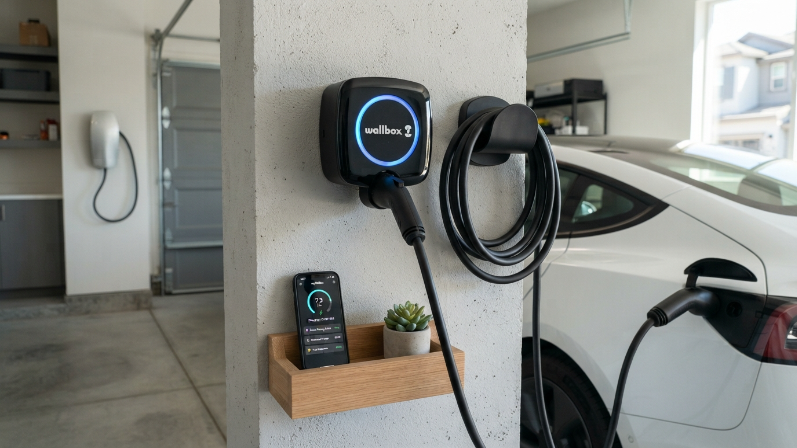
3. Wallbox Pulsar Plus
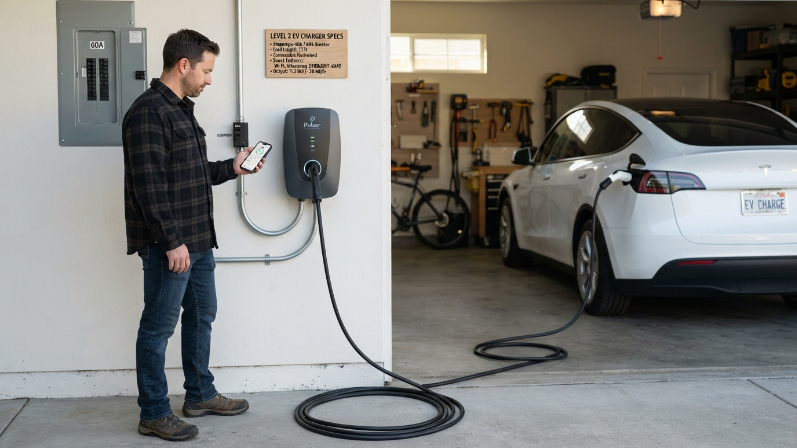
The Wallbox Pulsar Plus wins on design and smart features. It is compact, sleek, and looks like it belongs in a modern home rather than a garage. If aesthetics matter to you, nothing else comes close. The unit is roughly the size of a small toaster, which is remarkable given it pushes up to 48 amps.
The myWallbox app offers power sharing if you have two EVs, which is a feature I have not seen executed this well anywhere else. You can also integrate it with solar panel systems and set dynamic charging schedules based on your energy source. At around $650 to $700, the price is competitive with the ChargePoint Home Flex. My one complaint is the cable management. The included cable holder works, but winding a thick cable around a small unit gets tedious. Still, the overall package is excellent, and Wallbox’s customer support responded to my questions within a few hours.
4. Tesla Wall Connector
Tesla owners tend to gravitate toward the Tesla Wall Connector, and honestly, it makes sense. It delivers up to 48 amps, integrates seamlessly with the Tesla app, and supports Tesla’s power-sharing feature called Load Sharing, which balances power across multiple Wall Connectors on the same circuit. The setup experience is buttery smooth if you already live in the Tesla ecosystem.
At $475, it is priced aggressively and offers tremendous value. The 24-foot cable and clean wall-mount design look great. Starting in 2024, Tesla also added a CCS adapter option, and the Wall Connector now ships with the NACS connector and a J1772 adapter for non-Tesla vehicles. So it is no longer Tesla-exclusive.
The catch? If you do not drive a Tesla, you can find chargers with better app ecosystems and broader compatibility features. But for Tesla owners specifically, buying anything else feels like an unnecessary complication.
5. Emporia Smart Level 2 Charger
Budget-conscious buyers should look seriously at the Emporia Smart Level 2 Charger. At roughly $450 to $500, it undercuts most competitors while still offering Wi-Fi, app-based scheduling, and energy monitoring. Emporia built its reputation on energy monitoring hardware, so the charging data you get through their app is surprisingly detailed.
It charges at up to 48 amps with a 24-foot cable, matching pricier options on raw specs. The build quality is solid, though the housing feels slightly less rugged than the Grizzl-E. I tested an Emporia unit at a friend’s house for a weekend and was impressed by how quickly it connected to Wi-Fi and how intuitive the scheduling felt. If you want smart features without paying $700, this is your pick. The only thing missing is UL listing at the time some early models shipped, so double-check the current certification status before purchasing, especially if your electrician requires it for permit approval.
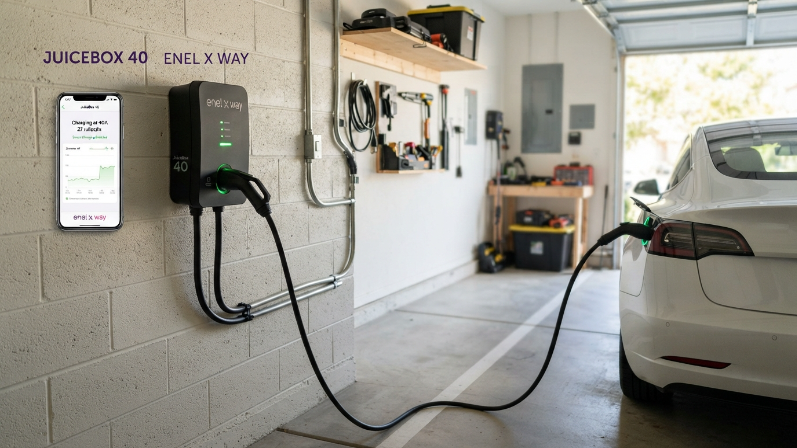
6. JuiceBox 40
The JuiceBox 40 from Enel X Way has been around for years, and it remains a reliable choice with a strong track record. It charges at 40 amps, comes with a 25-foot cable (one of the longest in this list), and supports full smart functionality through the JuiceNet app. One feature I genuinely appreciate is the built-in power management, which adjusts charging speed based on your home’s real-time electrical load to prevent breaker trips.
Priced around $600 to $650, it sits in the mid-range. The app occasionally has hiccups, based on what I have seen in user forums and my own brief testing, but Enel X Way has been pushing consistent updates. If cord length is a priority or you need the power management feature because your electrical panel is near capacity, the JuiceBox 40 handles both beautifully.
Installation: What to Expect and What It Costs
No guide about the best home charging stations for electric vehicle owners is complete without talking about installation. The charger itself is only half the equation. You also need the right electrical setup.
Most Level 2 chargers need a 240-volt circuit, similar to what your dryer or oven uses. If you already have an unused 240-volt outlet in your garage, you could be up and running in minutes with a plug-in charger. If not, you will need an electrician to run a new circuit from your breaker panel.
I paid $350 for installation, which included a new 50-amp breaker, about 15 feet of wiring, and a NEMA 14-50 outlet. Costs vary widely depending on how far your panel is from the garage and whether your panel has capacity. Some homeowners need a full panel upgrade, which can push costs to $1,500 or more.
A quick tip from my experience: get two to three quotes from licensed electricians. The first quote I received was $900 for the same work I ended up paying $350 for. Prices vary wildly, and there is no reason to overpay.
Also check your local utility company for rebates. Many offer $200 to $500 off charger purchases or installation costs. Some states also offer tax credits. I stacked a utility rebate with a manufacturer promotion and saved $400 total.
FAQs
Can I install a home EV charging station myself?
If you are using a plug-in charger with an existing 240-volt outlet, yes, you just mount the unit and plug it in. But running a new electrical circuit absolutely requires a licensed electrician. Electrical permits may also be necessary depending on your municipality. Skipping a professional for wiring work is dangerous and could void your homeowner’s insurance.
How fast will a Level 2 home charger charge my car?
Most Level 2 chargers add 25 to 40 miles of range per hour depending on amperage and your vehicle’s onboard charger capacity. A typical EV with a 60 kWh battery goes from 20% to 100% in roughly 6 to 8 hours on a 40-amp charger. Overnight charging covers nearly every daily driving scenario.
What is the best home charging station for electric vehicle owners on a budget?
The Grizzl-E Classic and Emporia Smart Level 2 are your strongest budget options. The Grizzl-E skips smart features to keep the price around $460 while delivering 40-amp charging and bulletproof build quality. The Emporia adds Wi-Fi and app scheduling for about $450 to $500, making it a great value if you want smart controls.
Do all home EV chargers work with every electric vehicle?
Nearly all Level 2 home chargers use the J1772 connector, which is compatible with every major EV sold in North America except Tesla, and Tesla includes a J1772 adapter with every vehicle. The Tesla Wall Connector uses NACS but now ships with a J1772 adapter too. So compatibility is rarely an issue regardless of what you buy.
Is it worth paying extra for a smart charger?
It depends on your electricity rates. If your utility charges different rates at different times of day, a smart charger with scheduling can save you real money by shifting all charging to off-peak hours. I save about $15 to $20 per month this way. If your rates are flat, a non-smart charger works just as well for less money.
Conclusion
Choosing a home charger boils down to your budget, your electrical setup, and whether you care about app-based controls. Any of the six chargers above will reliably charge your car overnight and make the EV ownership experience feel effortless. So which one caught your eye, and what does your garage setup look like?